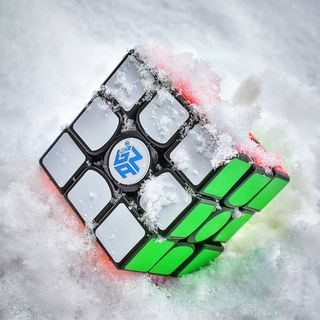
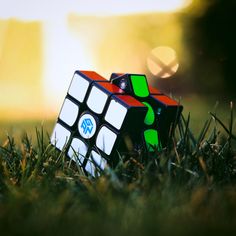
Speedcubing (also known as speedsolving, or just cubing) is a sport involving solving a variety of combination puzzles, the most famous being the 3x3x3 puzzle or Rubik's Cube, as quickly as possible. For most puzzles, solving entails performing a series of moves that alter a scrambled puzzle into a state in which every face of the puzzle is a single, solid color. Some puzzles have different requirements to be considered solved, such as the Clock, for which all the dials must be moved into the 12 'o clock position.
The standard puzzle sizes are 2x2x2, 3x3x3, 4x4x4, 5x5x5, 6x6x6, and 7x7x7 and the different variations, 3x3x3 one-handed, 3x3x3 blindfolded, 4x4x4 blindfolded and 5x5x5 blindfolded. There are also different shapes of the famous puzzles, including Pyraminx, Megaminx, Skewb, and Square-1. An individual who competes in speedcubing is known as a speedcuber.
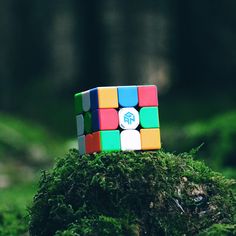
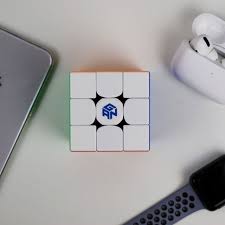
The standard 3x3x3 can be solved using a number of methods, not all of which are intended for speedcubing. Although some methods (such as CFOP) employ a layer-by-layer system and algorithms, other significant (though less widely used) methods include corners-first methods and the Roux method. CFOP, Roux, ZZ are considered as the "Big 3" methods, as they are the most popular and can be used to achieve faster times than the others. The "big 3" used to be a "big 4" with the Petrus method as well, but, due to low popularity of people using this method, it had to be taken out from the "big 3". The CFOP method is used by most speedcubers.
Since 2003, speedcubing competitions have been held regularly. The World Cube Association (WCA) was formed in 2004 to govern all official competitions. For a competition to be official, it must be approved by the WCA and follow the WCA regulations. Included in the regulations is the necessity of having one or more WCA delegate in attendance. A delegate's main role is to ensure all regulations are followed during the competition. Once the competition has finished, the results are uploaded on to the WCA website.